

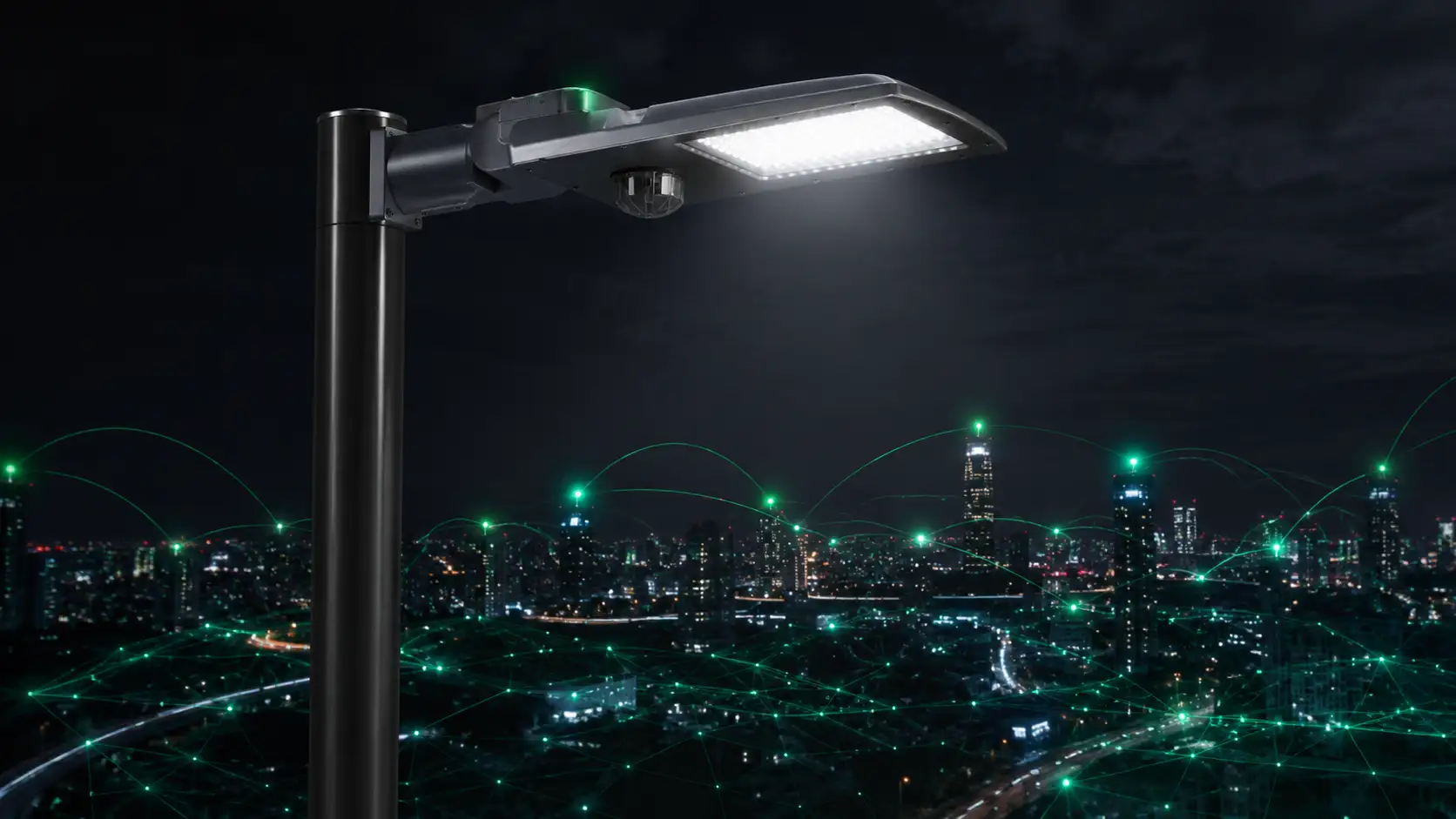
The Infrastructure of Tomorrow: Building a Seamless and Scalable Smart City Lighting Topology
As urban centers expand and the demand for energy efficiency intensifies, municipalities and infrastructure managers are facing a critical turning point. Traditional street lighting networks, once sufficient, are now revealing their structural limitations. The transition toward a true Smart City is no longer just about replacing conventional bulbs with LEDs; it is about establishing a robust, intelligent, and infinitely scalable communication topology.
The Bottleneck of Legacy Architectures
For years, many large-scale outdoor lighting projects relied on complex intermediate hardware, such as fragmented DMX converters and short-range antennas. While these legacy systems introduced basic control, they also created significant vulnerabilities. Limited signal ranges (often restricted to 500 meters) and heavy hardware dependencies resulted in severe communication bottlenecks. More importantly, the lack of end-to-end telemetry left operators with “maintenance blindness,” unable to detect localized luminaire failures in real-time.
Embracing the LoRaWAN Standard for Maximum Reach
To overcome these structural hurdles, modern urban infrastructure requires a wireless protocol built specifically for vast distances and secure data transmission: LoRaWAN (Long Range Wide Area Network). By integrating an industrial-grade LoRaWAN backbone, cities can eliminate vulnerable intermediate bridges. A single gateway can securely manage hundreds of nodes across kilometers of urban terrain, drastically reducing both initial deployment costs and long-term hardware maintenance.
A Unified Topology: From Server to Luminaire
A truly seamless smart city topology operates on a perfectly streamlined hierarchy. At the core of this evolution is a centralized management interface—such as the OptoOS platform—which provides real-time mapping, precise scheduling, and granular diagnostics.
The communication flow becomes elegantly simple:
- The Central Server: Hosted securely in the cloud or on-premise, deploying commands instantly without latency.
- The Gateways: Strategically positioned LoRaWAN gateways distribute the wireless signal across the project area, ensuring a resilient network with zero dead-zones.
- The Intelligent Nodes: Utilizing industry-standard interfaces such as Zhaga (D4i) and NEMA, or versatile multi-driver controllers like the PoiNode, the signal is executed directly at the luminaire level.
Flawless Synchronization and Future-Proofing
Scalability is the defining metric of successful smart infrastructure. A modernized LoRaWAN topology is inherently future-proof. Adding new streets, parks, or entire districts to the network requires no disruptive physical wiring or complex converter configurations. Furthermore, by utilizing GPS-based real-time clock synchronization, entire municipal grids can operate in absolute harmony, executing dynamic dimming and adaptive lighting scenarios with zero signal lag.
Conclusion
Building the infrastructure of tomorrow means stripping away unnecessary complexity. By transitioning to a streamlined, IoT-driven topology, cities can achieve unprecedented energy savings, eradicate maintenance blind spots, and lay a resilient foundation for future smart city integrations.
No Comments