

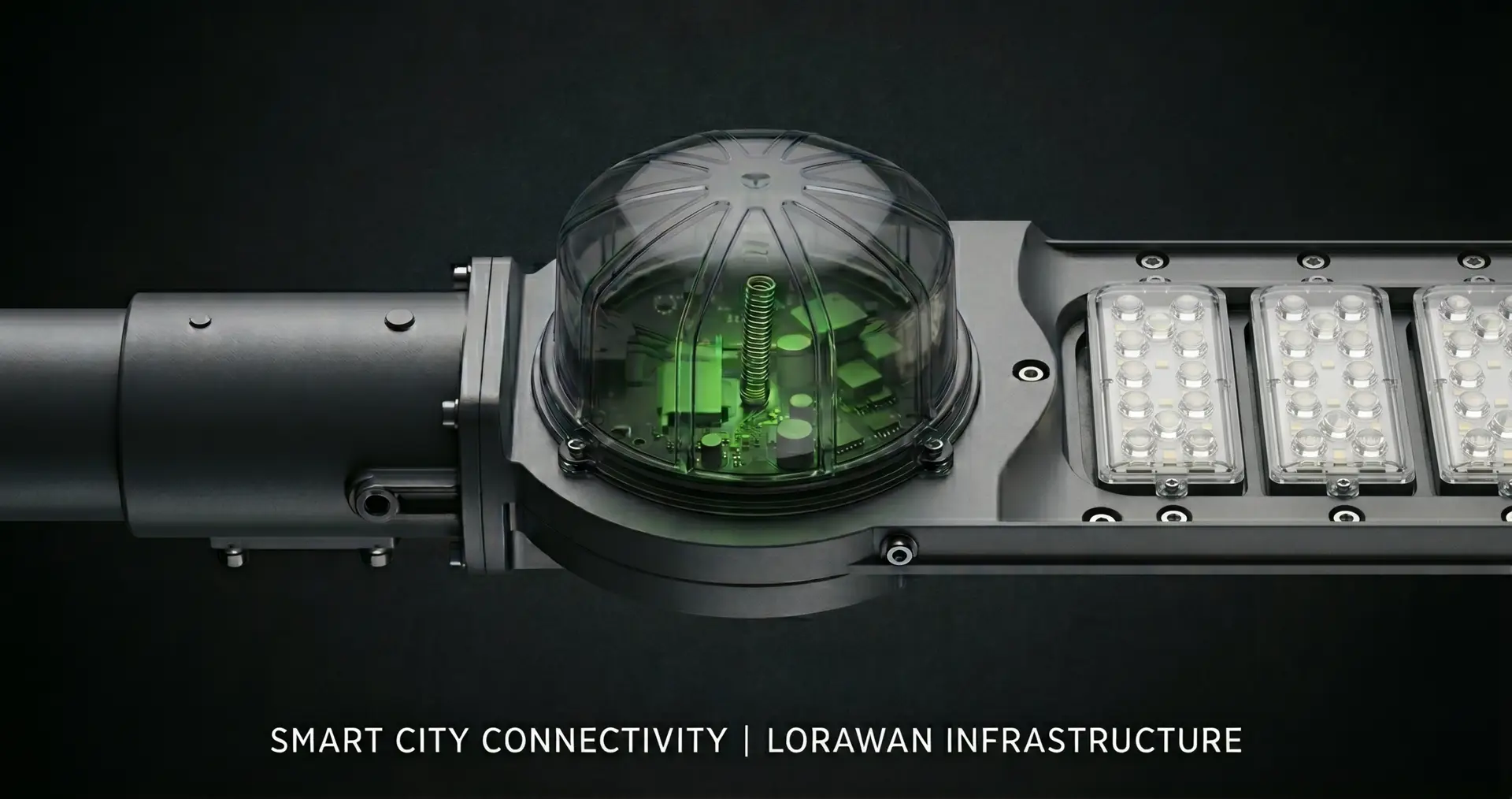
LoRaWAN Street Lighting: Urban IoT Infrastructure Guide
LoRaWAN Street Lighting: Urban IoT Infrastructure Guide
Why use LoRaWAN for smart city street lighting? LoRaWAN (Long Range Wide Area Network) is a low-power, long-range communication protocol highly effective in dense urban environments. By utilizing existing street lighting columns as network nodes, UK councils can establish highly reliable, city-wide IoT coverage for environmental monitoring, smart parking, and lighting telemetry without requiring expensive new groundworks.
Introduction
The foundation of any smart city is its communication network. However, establishing city-wide connectivity for thousands of IoT devices presents a massive logistical challenge. Cellular networks (4G/5G) often carry high data costs and consume too much power for simple telemetry, while traditional Wi-Fi lacks the necessary range. For UK municipalities looking to build scalable and resilient infrastructure, the solution lies in LoRaWAN, deployed directly via the street lighting grid.
Why Streetlights are the Perfect Host
Street lighting columns possess three critical attributes that make them the ideal backbone for a LoRaWAN network:
- Height & Line of Sight: Elevated luminaires provide unobstructed signal paths, crucial for maximizing the range of LoRa antennas.
- Mains Power: While LoRaWAN end-nodes are exceptionally low-power, the gateways require continuous power, which the lighting grid readily provides.
- Even Distribution: Streetlights are already perfectly spaced across every road, high street, and residential area, ensuring uniform network coverage without installing new masts.
LoRaWAN vs. RF Mesh
While RF (Radio Frequency) Mesh networks are popular for street lighting control, LoRaWAN offers distinct advantages for broader smart city applications. Operating on the sub-gigahertz frequency band (868 MHz in Europe/UK), LoRaWAN signals excel at penetrating concrete buildings and dense urban architecture. A single LoRa gateway mounted on a smart pole can communicate with thousands of sensors situated miles away.
Powering the Environmental Ecosystem
Once a LoRaWAN network is established via the lighting grid, the municipality unlocks an open ecosystem of possibilities. Councils can easily integrate third-party, battery-operated sensors to monitor urban health. This infrastructure is ideal for establishing comprehensive carbon calculation systems, tracking localized air quality, and logging environmental data in real-time to meet strict ESG (Environmental, Social, and Governance) targets.
Unified Data Aggregation via OptoOS
The true value of a LoRaWAN infrastructure is realized when the data is actionable. Modern Central Management Systems, such as OptoOS, act as the command centre. Instead of juggling multiple vendor platforms, city engineers can monitor streetlight health, adjust dimming profiles, and analyze environmental carbon metrics within a single, unified dashboard.
Conclusion
Integrating LoRaWAN into urban spaces via street lighting is the most cost-effective and scalable method to build a smart city backbone. By leveraging existing vertical real estate, UK councils can establish long-range, low-power networks that drive both immediate lighting efficiencies and long-term environmental sustainability.